Upcoming Webinar: How To Better Retain Customers
Save My Spot


1. Forward Planning Drives Success: Success at overstockArt.com came from disciplined, forward-looking planning, backed by a strong team. David planned about two quarters ahead so that inventory and product development were ready for the busy Q4 season.
2. Prioritize Customer Retention: Selling art online was a new concept when David founded overstockArt.com. By leveraging customer retention as a business strategy, the company grew, amassing a supportive community of art collectors.
3. Value Cultural Fit During Hiring Process: David hired based on cultural fit, believing that strong candidates must get along with the rest of the team and align with the company’s mission and values. Basic work skills can be taught, but fit cannot.
4. Test/Validate Your Idea: David reminds aspiring E-Commerce entrepreneurs to validate your idea cheaply by putting it in front of real buyers and listening to their feedback early before officially bringing it to market.
5. Focus on 5 Goals Each Quarter (No More): David stresses that in entrepreneurship, having too many goals means nothing gets done. Capping each quarter at a few priorities (no more than 5) kept overstockArt.com focused on stocking its best sellers, which freed up cash for marketing.
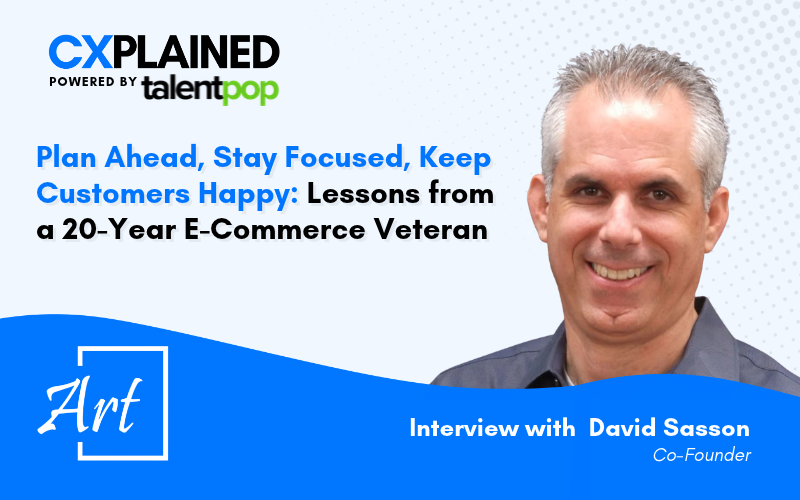
When David Sasson launched overstockArt.com in the early days of E-Commerce, selling art online was a brand-new idea. Despite grainy images and slow dial-up connections, he built a community of art collectors by pairing exceptional customer experience with disciplined planning. Today, David is a coach at ActionCoach, helping aspiring entrepreneurs grow their businesses. Here, he reflects on his 20 years running overstockArt.com and shares the strategies and personalized customer service that made it the largest online marketplace for hand-painted reproductions of famous masterworks.
Meet David Sasson, Co-Founder of overstockArt.com!
overstockArt.com is the largest online retailer of handmade oil paintings in the United States. overstockArt's specialty is hand painted reproductions of famous oil paintings of past great artists like Van Gogh, Monet, Renoir, Klimt and many more.
Originally from Israel, David Sasson moved to the United States in the early '90s to attend school, eventually joining Apollon Computers. "I was CEO of the company, and we worked with a lot of dotcoms in the late '90s and early 2000s," he explains. When a friend showed him a collection of exceptional hand-painted oil paintings, the two recognized an opportunity: a unique product paired with a promising business model. "We started in 2001 and envisioned a new way of reaching consumers – the Internet. E-Commerce was very new back then."
After selling paintings through partner sites, they built their own website, and sales really took off. "We were completely self-funded," David recalls, "but we could see real interest from consumers and decided to go after it, investing in a website, building a warehouse and a team, and creating the concept of selling art online."
As co-founder of a self-funded, bootstrapped startup, David says, "we wouldn't exist if it weren't for the opportunity of E-Commerce." overstockArt.com started as a home enterprise for David and his wife – also new parents at the time – working out of an upstairs "office" and a downstairs "warehouse." "We couldn't reach the customers without the Internet, so the Internet was everything for us," he says, noting their business vision was to build a direct-to-consumer model. "That's the way you increase your margin. You're able to control the distribution system as opposed to being dependent on people all the way through."
overstockArt.com began as a small multinational company, with offices and studios in the United States, China, Israel, Vietnam, and Eastern Europe, centered in Ukraine. Growing a startup that relied on advanced technology and marketing, David found that sourcing talent overseas was ideal. "Cost is always a concern as you're scaling your business," he adds. "So, we held the majority of our team in the United States for order fulfillment and customer service."
David credits a strong, competent team with keeping overstockArt.com on track to meet its goals and grow. As leader, most of his own work focused on strategy, marketing, and building sales relationships with commercial accounts. Meeting with team members to improve order fulfillment, customer support, and overall customer satisfaction was also a top priority. "We were very meticulous about planning every quarter," he explains. "Q4 was our biggest quarter. We knew that if we didn't start planning in Q2, we weren't going to have a great Q4 for inventory availability and product development."
As the original operators of overstockArt.com, David and his wife reinvested everything the business earned. Because David was running another company at the time, the couple had a financial cushion that allowed them to leave their profits untouched. He understands that most founders don't have that luxury. "Sometimes you must live off what you're bringing in," he says, emphasizing that the more you reinvest, the more your company will grow.
When overstockArt.com launched in the early 2000s, most people were still accessing the Internet through dial-up modems. Web pages loaded slowly, and images lacked clarity and definition. "We sold art, which is the ultimate visual product. We knew our first sale was going to be difficult. So, it was all about the second sale," explains David. "We always wanted to give you something that looked better, felt more exciting, and left you thinking, 'How can I put another piece in a different room?' That was our CX philosophy from the start, and it has never changed." Taking care of customers proved to be a successful business strategy: overstockArt.com recorded 52% customer retention, a high number for a non-consumable product.
Asked about going the extra mile for a customer, David recalls one hard-to-please client who had made a considerable investment by ordering four artworks. "Our operations manager arranged to have all the pieces shipped back. We then sent the images to the studio and customized everything by hand to her specifications," he remembers. The team sent the new pieces back, and she was ecstatic. "She called me, and we talked for a while," David says. "She was a great person. Sure, we lost money on the transaction, but we feel the goodwill comes back around in a roundabout way."
As a growing company in the early days of E-Commerce, overstockArt.com relied on customer retention. "The only way to get that second order was to cultivate a culture where you are committed to the happiness of your clients," David stresses.
David's goals fell into two categories: financial and development. "We always set sales goals and a gross margin goal," he explains. "Then key costs. We either look at a specific dollar amount or a percentage of revenue, so that we're staying aligned with business growth."
He believes scaling companies should have no more than five priorities each quarter, noting that many entrepreneurs lose sight of major goals because they are juggling close to 20 projects at once. "We were very meticulous about setting only key priorities so that the organization could focus on these areas and make sure that we grew as a business," he says. For example, overstockArt.com made sure its best-selling products were always available. "We built our own supply chain with specific algorithms to ensure that we were able to maintain inventory of key items. It was a very successful approach because it allows us to reduce our overall inventory while improving our overall availability, which releases more cash into your company and allows you to invest more in marketing," he notes.
"My first piece of advice, if you haven't already started, is to vet your idea with as little money as you can," David says. Get your product or service in front of people, ask them to buy it, and request their honest feedback. "See what people are saying," he stresses. "When we started overstockArt.com, the first thing we did was put the product on online auctions."
If sales are going well, develop strategies that focus on scaling, such as investing in a warehouse, raising funds, or taking out a loan. "Cost of capital comes into play, especially now that interest rates are higher," David reminds aspiring entrepreneurs. "Look at the math behind growth."
Lastly, David emphasizes the importance of deciding what kind of business you envision. "Do you want a lifestyle business, or do you want to build a brand? Those are two very different approaches. So set your goals, personal and business."
Can’t-live-without-tool? Claude
Key hiring trait? I look to see if they are going to fit my team and fit the culture of the company. If we feel they are a good fit, we can usually train the majority of the other things. But they need to fit not just the job and the role, but also our culture.
Recent book or podcast? It’s not the last one I read, but it’s the one that I keep coming back to. It’s an old book from the 80s called The Goal. It was written by Eliyahu M. Goldratt. It’s about the process of ongoing improvement. It takes place in a manufacturing environment, but you can apply the idea to anything. The first time I read it, it introduced the theory of constraint, and I think it’s incredibly powerful. We use that in a million different ways in our business. It takes a lot of thinking to do it sometimes because it’s not always direct connections. But the story that I told you earlier about the inventory that we did, that’s directly out of the theory of constraints. We used their methodology and embedded our own environment, our own variables into it.


We're elevating customer experiences at 500 top E-Commerce brands (and counting). Let's see what we can do for you!
Learn MoreBook a call with one of our specialists today to see how TalentPop can assist you with putting together a solution for your customer service needs.
Learn More