Join our upcoming Webinar on How to Convert More Shoppers and Deliver Flawlessly This BFCM →
Join now

1. Foster Meaningful Customer Relationships: Amy and her team shifted their customer experience strategy from a traditional CPG model to one focused on authenticity, personal connection, and storytelling, recognizing that wine is a communal and experiential product that consumers want to connect with on a deeper, more human level.
2. Be Ready to Pivot: By leveraging data, Amy identified a mismatch between initial target demographics (young millennials) and actual customers, leading to a strategic pivot toward serving an older, more wine-savvy audience that values regional authenticity and quality.
3. Maintain an Adaptive Approach to Business: Amy and her team discovered that product quality and convenience, rather than sustainability, were the main drivers for their customers—prompting a shift in marketing strategy to focus on effectively reaching and resonating with the demographics already interested in their offering.
4. Build a Curious and Flexible Team: Amy values team members who are adaptable, curious, and willing to grow beyond their core expertise – favoring individuals who can "change lanes" when needed and contribute creatively across functions to build a more dynamic and versatile team.
5. Be Persistent, Prepare for the Unexpected: Amy believes that success in E-Commerce requires adaptability, persistence, and constant vigilance; Amy emphasizes the importance of being prepared for the unexpected, maintaining realistic expectations, and being willing to pivot quickly – all while staying deeply engaged and committed to the business.
When Amy Troutmiller was presented with the idea of launching a high-quality boxed wine brand, she saw a unique opportunity to disrupt a long-overlooked corner of the alcohol industry. Traditionally, boxed wine carried a reputation as a low-quality option. But Amy and her team at Really Good Boxed Wine are changing that perception, building a community of moderate drinkers who appreciate a single glass of luxury wine, made in Sonoma County, that stays fresh in the fridge for weeks.
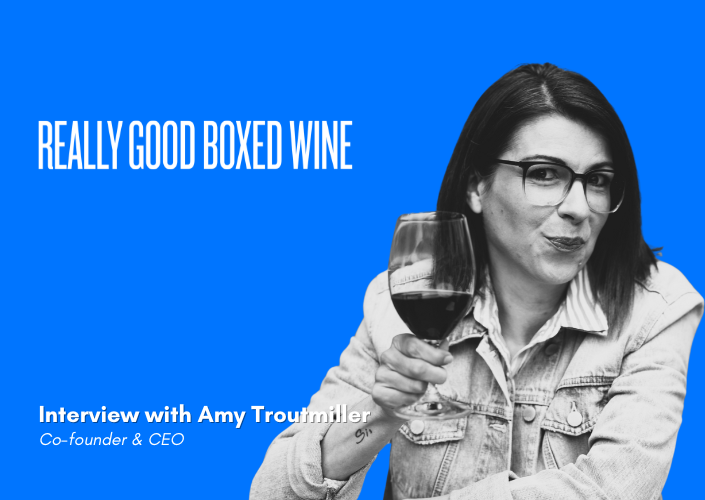
Meet Amy Troutmiller, Co-founder &CEO of Really Good Boxed Wine!
Really Good Boxed Wine is on a mission to make fine wine more approachable, affordable, and sustainable. Crafting wine in the same style as luxury bottles, they use the boxed wine format to deliver savings of over 50% retail price and a 20x longer drinking window after opening than glass.
Every wine is vintage, varietal, and region-specific, sourced from premium, family-owned vineyards in Sonoma, Napa, or Paso Robles.
Amy Troutmiller, has spent decades building her career in the wine industry. In 2021, when Jake Whitman – her future co-founder – approached her with an idea for boxed wine, she immediately recognized an opportunity for innovation. “I deeply understand what consumers need and what the quality threshold is for great wine,” Amy says. “And no one was putting great wine in a box.”
An eco-friendly alternative to bottles that was first introduced in the 1960s, boxed wine has always carried a reputation for being low quality. “There’s no technical reason that it has to be,” Amy explains. “Especially today, when so many people are drinking in moderation and don’t want to open a whole bottle, the preservation system of a box allows for the modern-day consumer to have one glass of wine at a time with it actually being the quality that they want.” Seeing a gap in the market, Amy and Jake nationally launched Really Good Boxed Wine with an original Cabernet in 2022.
In the early days, Really Good Boxed Wine was just Amy and Jake. But after securing seed funding in 2022, they were able to expand, bringing on Amy’s right-hand woman as their first full-time hire, along with a team of contract workers to support the company’s most critical needs.
Really Good Boxed Wine operates as a fully remote company. Amy is based in Washington, D.C., the winemaker works out of Sonoma County, and members handling IT, accounting, and other functions are spread across the globe. “We’re an international community,” says Amy.
Amy’s previous e-commerce experience was rooted in traditional business operations, initially applying a standard consumer packaged goods (CPG) model to customer experience. But that approach shifted quickly. “Wine is such a unique thing—it’s inherently communal and experiential,” Amy explains. “People wanted to know who was behind the brand. They wanted that connection with us – they wanted the story.” In response, the team adapted their CX strategy to emphasize personal connection and storytelling. “Customers are buying something authentic – something we care deeply about. It’s not just a product from a factory; it comes from the land. And now we get to talk about that a lot more,” she adds.
Specialized Customer Service for Wine Club Members
The company established a dedicated email channel for wine club members, managed by the Director of Operations, with Amy occasionally stepping in. “The questions are usually more specific to wine pairings or perks of our wine club,” Amy says. Day-to-day customer support tickets are handled by a third-party team trained in standard operating procedures and equipped with a solid understanding of wine.
Key Strategy Boosting Growth: Know Your Customer
“I’m a big believer in data. It allows us to say, ‘This is what the market is telling us,’” Amy explains. After discovering that their actual customer base differed from initial projections, she reassessed key market strategies with a renewed focus on growth. Instead of the expected younger millennial demographic, the core audience turned out to be older consumers – those 40 and over – with more developed wine knowledge and an appreciation for what labels like Sonoma and Napa Valley signify.
They also initially assumed that sustainability would be a primary driver of purchase decisions. However, the real appeal lay in offering high-quality, convenient boxed wine, especially for moderate drinkers. “It changed the way we approached targeting,” Amy reflects. “We realized we had specific demographics already drawn to our product, and the question became: how do we reach them more effectively and speak directly to those who are already looking for what we offer?”
How a Boxed Wine Company Prepares for Peak Season (AKA The Holidays)
October, November, and December is the peak sales period for the alcohol industry. To prepare, the company takes an all-hands-on deck approach that includes pre-planning and setting up automation. Amy also views this busy time as an opportunity to leverage their wine club and cultivate loyal relationships with customers going into the new year. Understanding that people are being blasted with promotional emails, she says, “we have to be really thoughtful about the content you’re sending out – segmentation is important.”
Dry January and August – when many people are traveling – are typically the slowest months for an alcohol business. “We do a lot of marketing around ‘Damp January,’” Amy explains. “You might be cutting back, but because our wine stays fresh for six to eight weeks, one box can carry you into the next month.” She adds that they frequently run ads promoting moderation. “We’re a winery that encourages drinking less without sacrificing quality.”
Amy’s Key Priorities and Goals for 2026
Looking ahead to 2026, Amy plans to expand into wholesale and explore new sales channels. “We believe in data and have done extensive research on how to be more successful,” she says. “We have some packaging updates that are going to serve us better on the shelf. She notes that, unlike E-Commerce, in-store retail doesn't allow for the same level of brand storytelling – so visual impact becomes even more critical.
Another top priority is ensuring the business grows at a healthy, sustainable pace. While Really Good Boxed Wine doubled its revenue from year two to year three, the margins weren’t ideal. “I think sometimes people just want the top line number to continue to go up. But if you’re not bringing anything to the bottom line or don’t have potential to, it’s going to be a failing business,” Amy explains, revealing that they spent the next year right-sizing margins and strengthening the company’s financial foundation. “Now we’re in a great place and ready to pour fuel on the fire to grow in all of our channels in 2026.”
Amy’s Advice for Aspiring E-Commerce Entrepreneurs
“You have to plan for the unexpected, have reasonable expectations, and be very quick to pivot,” Amy says, reflecting on the unpredictable nature of E-Commerce. Building a successful online business takes patience, resilience in the face of failure, and the ability to recognize when change is needed. When Really Good Boxed Wine launched, Amy was working 11- to 12-hour days. “I was never separated from the business,” she says. “You have to stay aware of everything that’s happening, all the time.”
Can’t-Live-Without-Tool? Shopify and SMS, which has become the best conversion tool. From that side of business – marketing and customer experience – SMS is the best tool for us. I think this goes back to email fatigue. Even if someone isn’t going to click, they still see a text message. We’ve had a really high retention rate on our SMS because we don’t inundate people. We send them things that we think they are going to be interested in or something that is funny to get them through the day.
Key Hiring Trait? I look for what I call highway drivers. It means you have a lane and a specific area of expertise, but if something is slowing you down, you’re ready to change lanes or merge. I don’t want anyone who only wants to do exactly what they know how to do. I like people who show some ability to be inquisitive, to contribute, and to bring creativity. If there’s something they want to learn, be honest about it so we can work together so they can develop new skills. I always look for people who have that adaptability to change lanes – both when it’s needed and out of their own interest. I think it makes a richer team if people contribute across functions.
AI or no AI?
I love AI. I think there are a lot of things to be fearful of but when AI is used for good for efficiency – absolutely. I am team AI. Like most people, I have reservations about how it can be troublesome in the future for the real world. But for professional application, I’m all for it.
Favorite Thought Leader in E-Commerce Space? I think Gary Vee is fantastic. He’s very good about encouraging people at any age and stage of life to believe that they can become entrepreneurs or change careers if they want to. It’s not just a young person’s game. And he’s done quite well in founding a few wine businesses, so he understands the space that I’m in.
Favorite Book or Podcast? I listen to true crime podcasts as a tool to get my brain to shut off so I can actually fall asleep. But the book that changed everything for me was Setting the Table: The Transforming Power of Hospitality in Business by Danny Meyer who founded Union Square Hospitality. Because I have been in food & wine for so long, his idea of how you both treat employees and people is something that I’ve carried through my whole career – as a leader and entrepreneur.
#1 Challenge as a Leader? I’ve had multiple businesses, and it depends if you have the fiduciary responsibility to others or if you are fully bootstrapped. The biggest challenge is that every decision that I make, because we do have investors, not just employees relying on the business doing well, but people who have believed in me and what we’re building is factored into the decisions that we make and the growth trajectory. Carrying that weight is the hardest challenge for me as a business leader. It’s knowing that I’m not just an island, but that I’ve got a lot of people around me and I want to do well for them.


We're elevating customer experiences at 500 top E-Commerce brands (and counting). Let's see what we can do for you!
Learn MoreBook a call with one of our specialists today to see how TalentPop can assist you with putting together a solution for your customer service needs.
Learn More
.png)
.png)